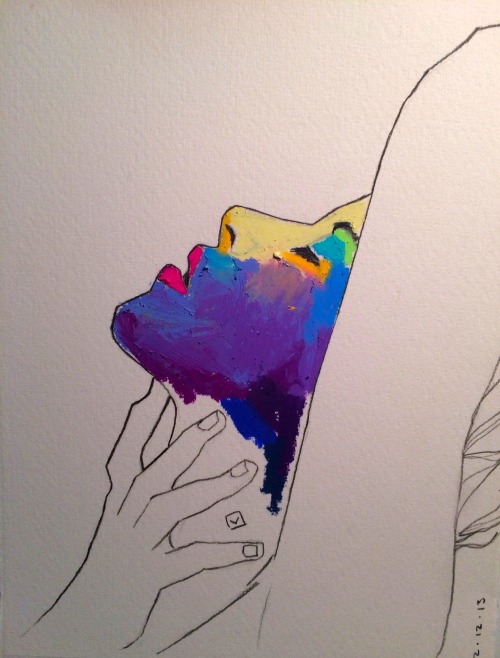
self perception and cookie dough

Monday, September 7

There was an errant spot of ice cream on the tiled kitchen floor from the prior week spent laughing and drinking cheap wine around the kitchen island.

They had sat on the floor passing a spoon back and forth, an ordinary couple with ordinary scars and ordinary hearts beating close together. She watched as he raised the spoon to his mouth and a small teardrop of creamy sugar landed between his legs. The wine made him goofy and he dared her to write a poem about this moment.

"Write about how good being drunk feels and how for some reason, the kitchen floor is made for drunk asses," he slurred, aiming the spoon down his throat. "A sonnet to the kitchen floor." They laughed and nearly choked on all the ice cream. Soon they laid their heads on the tile, staring across at each other, the drip between them already drying.

"I like that you have tattoos because it proves you are tough. You're artistic and driven and sexy and alive," he breathed across to her, letting the words settle onto her collar bone.

"Stop it," she said, picking the words off and sprinkling them back across his chest. He caught her wrist and held it tight against his neck.

"You are. And you always show the world exactly what's inside. There's nothing hidden with you. You're point blank, bulletproof, made of eyeliner and rose petals." He paused and his sleepy-drunk eyes were half smiling as he tried to pull her back into focus. "What do you want to do for your birthday next week? Have any plans in mind?"

She hadn't planned at all; she knew where she would end up. That next week, she watched her black tears land on the ice cream drop and wake the moisture in it back up. The sobbing couldn't stop, no matter if she scrunched her eyes shut, if she opened them wider and let the air snuff it out, if she tried to think of better moments on the kitchen floor.

But now, two hours into twenty three, already feeling the hangover pressing against the base of her spine, she spread herself alone against the cruel, cool, tile. She's so afraid of being alone, so afraid of being called a fraud, so afraid of her hair dye and eyeliner flowing down the sink at the end of each night. She's terrified her words will never help another sixteen year old girl who is thinking of ending it all just to have some damn peace. That everything that has hurt her and made her bleed from her kneecaps and her thighs and her nose are the only thing inside her. That every unkind word was right all along.

The kitchen floor is the best place for drunk people. It's the perfect place for ice cream stains and for watching the delicious secrets of the world crumble around you like cookie dough with too much flour added. It's the perfect place to pick yourself back up, tuck your own secrets away, and stumble into the bathtub.

via *

Be Prolific Series: Chris Bodily

Tuesday, September 1

It's interesting to be someone associated vaguely with the art world. You end up seeing people time and time again, circle past each other in your own groups, sharing a smile here and there,  but never really talking with each other. I've known Chris Bodily, or known of him I guess I should say, for years since I lived in Cedar City, Utah a few years ago. I've always adored his art and I own quite a few pieces that I'm very proud of. Somehow I'd never had a conversation with him and I've been dying to have one and I'm so glad I finally had my chance.

Chris, the artist behind the work known as Hatrobot is the quintessential artist when he speaks. It's like I can watch the ink pen maniacally shaking in his head as he speaks, eyes darting quickly, chasing each idea as he talks, sketching something in his mind that will inevitably become something astounding in his sketchbook. There's a knowing, haunting quality in his words and in his smile; it's an honor to hear him speak and share himself. I cannot wait for you all to read the interview below. Please enjoy and go show his artwork some love.

*All photos in the post used with permission of Chris Bodily.


When did you start drawing and why?

I've been drawing since I was a child. I watched a lot of cartoons on TV and I read a lot of comic books: Scooby Doo, He-Man, The Simpsons was a big influence, Ninja Turtles. ALso my sister used to own a book store and when the book store went under, I inherited the comic book collection from there. I would read through them and art became my thing. I learned to draw by watching The Simpsons. I'd watch it and pause it and draw the characters from the screen. It was something I loved doing.

I mean, I just loved cartoons, all cartoons. I think The Simpsons is where I learned to draw becuse at the time it was very popular at school so when I learned how to draw Bart Simpson I could be much cooler than I was.

When I got a little older, I read this book by Chris Ware called Acme Novelty Library and it opened my eyes to the potential art could have toward having a deeper social meaning, even with simple cartoon line work. My work now is an amalgamation of the cartoony of my childhood and the cathartic adult sensibility of who I am now. 


How would you classify your art?

I would say primarily it would be considered low brow or pop surrealism. I call it illustration. Really, you know, I feel like more than anything I do the type of work I enjoy doing and let it be whatever it's going to be. 

What themes do you generally play with in your art?

Mm, well... you know. The work I do is really train of thought. I don't sit down at a piece of paper with a preconceived idea in my mind and I let whatever forms embrace what I'm reading. So you know, anything that I'm reading or thinking or listening to, my emotional state of being too. All of that feeds into the work and shapes it. I try and just allow that subconscious train of thought to embody itself on the page. 


Where did you come up with the name Hatrobot for your art?

I could give you the history of it, but I think the more interesting thing is, the name Shakespeare didn't mean anything until after he earned his place. Hatrobot doesn't mean anything but it embodies the work that I do. Hatrobot is the work I do; it's kind of arbitrary. I wrote a comic zine in high school called Hat and when I built my website it became Hatrobot, the robot version of Hat. You know, it's a distinct name. When people google Chris Bodily, you get articles about Chris Brown but when you google Hatrobot you find me.

I've noticed a lot of your art has themes of horror or monsters. Where does that come from?

Well, I'm bipolar and I think for me art is very cathartic. I would... I feel good about being able to use my dark places and my internal conflicts and being able to create something beautiful rather than do something destructive. It's almost like my pieces are psychological self portraits of me working through personal issues.


Are you working as an artist full time?

Yes! Um yeah, its hard. Well it was hard and I think it was hard to get to the place I am now. I feel like, you know, a lot of people see the end result and they thing it was something you just walk into. It took then years to build the portfolio I have now. I worked a lot of part time jobs and I was broke a lot of the time. It took a long time to figure out how the business of art works. It was not an overnight thing. Somebody said once, "It takes ten years to make an overnight success." So yeah, it took work to get me where I'm at and I still try to be disciplined and I draw at least five hours a day if I can.  I make sure that everyday I'm doing something to continue the progress. As far as hard, it's not hard to get to do something you love. Right now I'm at a point where the hard work has paid off.

Do you have a favorite piece of art you've created?

It's hard to pin down a favorite piece because I would say there are pieces that are more personal than others. A Heavy Heart is not only one of my most personal pieces, it's also the piece that was the turning point in my career of going from being broke to being successful. It's what I would say is the most personal of my pieces.

I went through some pretty dark times. And the pieces that mean the most to me are the ones that came out of that time period. They are what helped me heal; they are what brought my life back together.

A Heavy Heart
I know that you do a lot of work in the Improv community. Does that come into your art at all?

Yeah, I look at improv like it's art by committee. It's still art, just in a different format. The idea of embracing your mistakes and the idea of trusting what you're creating and the juxtaposition of ideas and all of that feeds back and forth. I think a lot about visual art when I'm doing improv, in the sense of layering and textures as far as the narrative and just the scene picture in your head and on stage. I think both disciplines work back and forth together.

What is your creative process like?

I just create the work. I wasn't in the habit of naming my pieces until I was creating them digitally because you have to name your files. I create the work to create it. There's a quote I took from a professor at Southern Utah University, "A zen potter creates a thousand pots and then destroys the pots. After a thousand pots, he can create whatever pot he wants." Art isn't something that hangs on the wall; it's the thing that happens when you are making the thing that hangs on the wall. I'm only an artist when I'm creating and then I move on and create more. That's kind of the process I go through. I want to continue to learn and crate, continue to change if my art changes. I embrace that change.


What other artists inspire you?

I know there's a lot. As far as those that influence me, Chris Ware really opened my eyes to the possibilities of what you could do with cartoons. Van Gogh. I didn't really like Van Gogh's work when I saw it printed in a book but I remember the first time I saw it in a museum. I saw the Impasto and I broke down crying and at that moment I understood. It was like a window to Van Gogh's life. That experience opened my eyes to the connection you can make with your art to the viewers.

How do you feel about the intersection of trauma and art?

My work is not perfect or polished but what I think the value of my work has is the raw honesty that I put into it. I think the thing that resonates with people who enjoy my art is that they can connect emotionally to the themes I put in my work. I think being honest with all of your experiences is what gives art its richness. And not that you have to experience trauma in order to create great art, but you shouldn't be afraid of embracing the difficulties into your life and incorporating that into your work.

This is my favorite of his works. It's called Fiction and Beauty.
I keep it right above my writing desk.
Does your wife inspire your art?

I'm certainly happier now than I was previously! I think my work now especially in the last couple of years, it changed a little in that now I'm more concerned with the craftsmanship. I'm focused on fine tuning my work and making it more...I don't have the word but I'm learning new skills. Right now it's not so much about finding a way to say what's inside me like it was; it's about learning better wasy to say that.

It's nice to have Chelsea. She believes in me and I believe in her and it's important to me that she can pursue her dreams and creative vision and it's important to her that I pursue mine as well. It allows me to take chances and explore and I think my work has improved more in the time that I've been with her than it ever has before. 


I KNOW RIGHT. They are perfect, get them out of here.
What is your favorite part of the artistic process?

My process has two main parts. I start out with the pen and ink drawing and then I scan it in and color it digitally but drawing by hand is definitely the most rewarding part. It's that interaction and discovery that I love to let unfold and I'm creating it. It's that process of discovery, of putting your hand down on the page and discovering yourself and creating something out of nothing. I think that's my favorite part, just as the ideas begin to appear.

Have you won any awards for your art?

I've got two Del Close awards, I've got an Indie Ogden award, Salt Lake City Weekly Arty Award and I just got People's Choice for the Utah Arts Festival. Those are the big ones. And it's nice to be recognized like that. I think when you win an award or some sort of achievement, it's not just based on your work. It's a testament to the people who believed in you and helped you, the people that have enjoyed your work and supported your work. It's not something I've done by myself. It's to all the people who helped me to achieve anything at this point. It's always nice to win an award but it's not the focus for me as much as it's a way of giving back to the people who have gotten me here.


One of my favorite pieces of yours is a feminist related piece. Do you often get involved in political statements with your art?

I used to be much more political with my work. Bach when I started doing flash cartoons I had a lot of political statements I was trying to make. I've dialed it back considerably; I try to keep my personal viewpoints on politics or religion to myself.

At the same time, I'm not afraid to champion the causes I believe in. I'm much less concerned with criticizing things I disagree with. I'm a big believer in feminism and equality so it's interesting to see how much doing something like that can resonate. When I did the piece for the Pride festival, I was really touched by the amount of people who have come up to me and said the piece really made a difference for them. People want to see themselves in the work around them. They want to know is my race, is my gender, is my point of view expressed somewhere in art and do I have a voice outside of myself? Am I part of a large community? If I do something political, I don't need to be snarky anymore. I'm not trying to criticize anyone's viewpoints and I don't think that bullying someone or making fun of their viewpoints helps them to change or open their mind. 


How do you find inspiration in a dry spell?

I don't really run into artist's block. I think in part because my philosophy is, like I said, you can create a thousand pots and destroy them all. I think it's like if there's an archer in the middle of a field and he's shooting at nothing, he has all of his skills. He has control of his body and he's shooting straight. The minute you put a target in front of him, there's nothing about what he controls and he's thinking about the target. When I'm working, I try not to think about the end goal of how it's going to turn out or if it will work, or if it will sell. I try to focus on where I'm at any present moment and I try to embrace that. 

Going back to improv, it's the rule that there is no such thing as a mistake if you embrace everything you do. If I embrace where I'm at no matter where I'm at be it manic, depressed, happy, excited, sad; if I embrace that or create for wherever I'm at then there is no wrong answer. If I create a piece that's no good, who cares? If I create a piece that's amazing, great! I'll put it on the website. The artistic process is what's happening when you work through ideas or emotions. What ends up on the page is just something else.

What do you want people to get from your art?

My work isn't for everyone and I don't think it's supposed to be. I want to create work that when somebody connects with it, that it connects with them on a personal level. I think the viewer's experience is always going to be different. There's no right or wrong to that. So if they see a piece and it's funny and makes them laugh, that's awesome! If someone sees it and it makes them emotional, awesome! If they see it for the technical skill in the piece, awesome! The viewer's experience is a creation all its own. My interaction when I'm crafting the work and then my work interacting with someone else is different. I like that ambiguity that once it's created it can be something new.


What is your advice to young artists?

My best advice is don't worry about getting recognized. Work on your craft, do work you're passionate about and that you believe in and put in the man hours to make it as good as it can be. Because you know, there's plenty of work out there for everyone with the advent of the internet. Everybody has a voice and it's totally democratized. You can get your work seen by thousands of people but like at the end of the day, that doesn't matter as much as what your experience is to your work. 

If you're not passionate about what you're doing, why are you doing it, right? There's not a ton of money in art so if that's your end goal, I would suggest going to something else. Just take your craft seriously and be passionate.

*****

Massive amounts of thanks to Chris Bodily for the cafe suggestion with endless cups of coffee and a great atmosphere. Also thanks to him for sitting down with me and sharing his brain. I love people who are unafraid of being themselves and he is a great example of that. He made me want to dig deeper into my own head and pull out as much as I can and let it all spill onto the page, unchecked. 

Please check out his work! Locally, it can be purchased at The Hive Gallery in Layton, Utah. They take his work to farmer's markets and comic cons in the area, as well as Craft Lake City. He also has a Society 6 page and many other links, listed below. Go love. 

while I was away

Saturday, August 22

Hello, my lovelies. I haven't been on here as often lately but I promise there is a very good reason for that. Here, let me show you.


I finally finished my novel. Longtime readers of this blog will know that I've been working on this bad boy since November 2013 when I challenged myself to participate in NaNoWriMo (National Novel Writing Month) and I won, writing 50,000 words that month. Finishing the rest was hard with school and now with my new big and important full time job (#adult) but I did it. On August 10, 2015 at 1:39AM I wrote the end. 86,729 words, 265 pages, and all of my heart. 

Thank you for reading my blog and my writing, for sticking around and letting me read your words too, and thank you for the endless support. All my love. 

for the alive

Wednesday, August 12

True story. The other morning as I washed the sleep off of my face, I noticed my neck in the mirror. The delicate flesh just above my collar bone was bruised with grip marks like I'd been strangled in the night. Hard. My flesh had bruised like fallen rose petals and I had no idea why.

I pictured the walls of my bedroom closing down and growing hands in the night, pressing into my body and daring me to scream or sigh out into the velvet night. I've never been afraid of a little choking, a little extra pressure so I can really feel my carotid artery beating in my neck. Make life feel more vital and impending.

I have yet to solve the mystery of my grips along my neck. Maybe it was my own hand resting gently on my chest and then suddenly pushing on my vocal chords with all of their strength. Playing with the control of breath. Making sure I don't get complacent. Teasing me so I remember to stay alive.

via *

lay me down tonight in my linen and curls

Tuesday, August 4

Last night I plucked the moon from the sky and shoved it straight down my throat. All this time they've told us it was made of curdled milk. It was made of sugar cookie dough and crinkled happily down my throat as it made its way down. The sugar dust stayed on my fingers and I sucked it all out from under my nail beds while I thought of you, no longer able to see the moon gazing down at you.

You didn't deserve her. The moon is made of pure dust and smells like fresh tulips in the first garden sprout of spring. She couldn't stand to look at you as you made your way down the street each night, sneaking in and out, promising love to one and yanking it away from another.

I drove comfortably down the street toward home, missing all of the usual potholes because these were my roads. I followed gently along the curves like how I trace the space between the moles on my arm. I trace them myself, while your fingers rot off and twist lifelessly down in the cement of your heart. I trace them and feel the moon bubbling in my throat and glowing in my chest.

via *

Be Prolific Series: Rod Heiss

Saturday, August 1

This month's interview was very special for me. I got to interview my Uncle Rod, an artist who has inspired me for years. I am so excited to share his passion and extreme talent with all of you. I have written about him before here and here but even those felt like I was skimming the surface. When I first decided to start this series, I had my uncle in mind. I had to know how I got my creative gift, something that has seemed to skip my immediate family. I wanted to know what was in his head, if we created the same. I'll tell you. What I learned from him during our interview has changed and inspired me and I cannot wait for you to read him.

Rod is a painter based here in Salt Lake City, Utah. His work is incredibly vibrant and emotional, the kind of work that is almost overpowering. Watching him speak about his art, his love of surfing, his near death experience, anything at all is amazing because he has an overwhelming vulnerability and passion for every single aspect of what he speaks on. Read on for a discussion of life, death, and the destiny of artists.

*All photos and videos in this post used with permission by Rod Heiss.

Me with one of my favorite pieces, "Dedication"

How would you describe your style of art and painting?

People have told me I'm an abstract expressionist but I don't like that term, it was used in the fifties and sixties. I like to say I'm an emotional expressionist. I like to be abstract, I suppose, but my painting doesn't feel abstract to me. It's more emotions and feelings. So I don't know how to describe my paintings except for emotional expressionist.

What themes do your paintings usually have?

Usually the themes are what I've gone through during the week. The colors will change dependingo n how the week has gone or even how the day is gone. When I do paint abstractly, but I've been delving into more realism now, I don't even have a plan in mind. The theme is that the actual canvas is my palette. Most painters have a palette to mix the colors and my canvas is the palette. The theme starts with the fist color I chose and then it evolves from there. I don't have a theme, I choose colors and then it turns into a point where you can tell my mood is based on how I chose the colors. They work and flow together. I try to keep myself free of themes. There's a Daoist quote I love that says, "Clay makes the pot but it's the emotions within that make it useful." That's what I do when I paint. You empty yourself of emotions that I get during the week. You're tired from work, you have a lot to think about and your vessel is getting full so when I paint it's getting emptied.
Number 17
At what age did you discover your love of art?

I don't know if you know the story behind it, Emma. I never was interested in anything creative, going to plays and museums was boring to me as a child. All the way until I was about 24, I wasn't even interested in drawing or anything. I even went to the Van Gogh museum in Amsterdam when I was 12 and I wasn't interested. I started noticing architecture in San Francisco where I'm from; I started noticing some interesting styles that the buildings had. My grandmother and I were talking about my interest and she said, "next time you come, let's go to the Marin County Civic Center." She had lung cancer at the time and couldn't walk very well but she said it was free to walk around the Civic Center as much as you want and she told me to walk around and enjoy. I fell in love with the building itself. Every time I go back to Marin County I go back to the building itself and I go to the cafeteria in homage to my grandma, your great grandma. 

This triggered something in me, the lines and flowing in the building triggered this creative need. That winter I came to Salt Lake City and I couldn't sleep one night. It was two in the morning and I found a PBS American Masters series with a documentary of Jackson Pollock. I never knew who he was before and so for that hour and a half I was mesmerized by what he did and how he painted. There is actual footage of him painting and that's the moment I said to myself that when I got home in a few days, I would buy art material and I'll start painting. I did my first painting when I was about 24 or 25 and I knew I had something. I was even able to see the painting that inspired me at the MEt and I sat down and looked at it for an hour and a half.
You have moved through a lot of artistic mediums. How do you decide which area of art to take part in?

It's all feeling. I'll give you a brief story about the switch from sculpture to painting. It was a drastic stop. Right now I don't do any sculpture, it doesn't even pop in my head. I was doing scuplture for around three or four years strictly. They would pop into my head at night, as many as 4 or 5 fully designed sculptures that I just needed to build. I took a trip driving a friend of mine to Virginia for grad school and while we were sleeping one night, I had this idea to start painting. And once that idea came, I was painting again. It was fifteen years since I did my last painting and that idea to get back to painting came back to me five years ago in June. I haven't touched sculpture, I just sort of stop.

I sort of find for me when my life... well... my sculptures are very structured and fine tuned. My painting is so organic but my sculptures almost look planned and when my life is in chaos and my life has no structure, my art tends to go into sculpture. I put form to the chaos. And then I met my wife, Marie, five years ago and my life became very structured and I wasn't use to where I ahd to be someplace at a certain time or home for dinner, I couldn't do this or that. I had to express differently. Now that I had this structure my art became free; I break away from this structure because I have structure in another place. It's the yin and yang of my creative. when I don't have structure, my art is straight forward and when I have structure I need to express it more freely.
Do you have a favorite medium?

No. It goes from place to place. I experiment. I'm a mad scientist. To paint sometimes I put paper down and I tear the wet paint on top of it to create texture. I have no set medium. The only thing that's really set is that the paint itself is acrylic but they way I apply it is different every time. 

When did you learn to surf and how did that affect your art?

It all came together from the years when I was about 25 to 30; they were my years of creating and when I opened my mind by studying art. I went to art school and it changed my life. That moment I went to school and started to paint the structure in my life dissolved and I saw the whole world, no blinders or anything. I didn't ignore anything and I wanted to experience it all. I was in the San Francisco Bay Area and there is a surfing spot for large waves called Mavericks in Half Moon Bay and I read an article about a Hawaiian surfer who came to surf there and he drowned. When I read that article I knew I had to surf. I was doing surfing, ski racing, sky diving, just to experiment with life.

Are you still as adventurous? 

Yes but I'm more cautious. Pain hurts more now that I'm 48. 

Are you working as an artist full time?

That's the goal but I actually build and design furniture and cabinetry for people's homes. That has been taking over my life for the last two years and art tends to be on the weekends but I am considered a professional artist because I've had shows and exhibitions around the country. I've had shows in New York City in Chelsea, in LA, Laguna Beach, San Clemente, here in Salt Lake City. I've had a lot of exhibitions here and an art show on the internet as well.
How long do each of your paintings take?

A few yeas ago when I was painting a lot because I had more time, on average the paintings took maybe half an hour. The way I paint doesn't take a long time but it creates something interesting. Recently paintings, because I'm getting into realism, takes me three or more hours. It also depends on the mood or the style. Sometimes it takes longer to mix the paint than to actually do the painting. 

What is your creative process like?

My process starts with seeing what's around me. I'm from the San Francisco Bay and I love going to the art galleries there. Once when I was really struggling with my creativity in this two month period of no painting, I saw this painting and it was incredible with these wonderful colors that were blending each together. I wanted to make it my own version, with acrylics instead of watercolors. My process goes from me having an idea and then sometimes halfway through a painting I see something and I change it right then. It's an evolution I think, something triggers something new. That's whre it starts. I need to paint and see how it all evolves. 

What other artists inspire you?

Pollock of course, Alexander Calder. I can name off some of the old ones. I've studied art for almost 25 years, reading the history. Picasso, Van Gogh, all of them. There is a recent artist and she is to me the most incredible artist. Her name is Jay Defeo. I saw her in New York and really, you don't see very many women abstract expressionists and for me, she is one of the most incredible I've come across. She lived in San Francisco and there is this beautiful painting she did called The Rose that I saw in the Whitney Musuem. It's 12 inches thick of acrylic paint. She painted it in her flat in San Francisco for four years. To get it out, they had to tear off the wall of the house to get the painting outside. She's astounding.
Can you tell me a bit about your near-death experience and how that influenced your creative drive?

Oh I knew that was coming up. It's a long story but I'll try to keep it short. There was a storm coming in to the Santa Cruz area from the Gulf of Alaska. We watched it for three days; surfers are very much weathermen. It was December 31st, New Year's Day. We decided to go surfing and when we got to Santa Cruz, it was completely flat. We searched all of the spots and finally we found a spot with semi decent three to four foot waves. It was mellow at the start but soon they turned from 4 fee to about 7-10 feet and when the currents changed I got stuck. I got hit by a very large wave and I got stuck in a space where the waves dig a hole in the sand that was about sixteen feet deep. Waves were hitting me every 15-20 seconds and they broke the leash that attaches me to the surfboard so I was stuck with no flotation device. 

The water was about 52 degrees and a wetsuit can only keep you warm for so long. I was losing all of my strength when a large wave came and held me under for a very long time. When I came up, I tried to take a breathe right when the net wave came and I breathed in all of the water instead. Every time I came up, I was just coughing as the next wave hit. I couldn't swim anymore after the 5th or 6th wave and this complete fear came over me and I still remember that fear and then the peace that came after it. They were so different. The fear of death when you know you are going to die is hard to explain but you have this total fear, not paralyzing. I kept thinking, "My friends will find my body in the morning." 

The peace that came after that was overwhelming. When you know you are going to die and it's ok. It's indescribable. I was content and happy and I was ready to die. I told myself that the next wave would be the last as I saw it build. I said i'll take one last look at my friends who were laughing at me at the time because they didn't know I was dying. I turned around and my friend was paddling out toward me. The look on his face was amazing because he saw how white I was with completely red eyes. He grabbed me and it took about a half an hour to get to shore. I wasn't any help and I felt bad.

That changed my life, not just my art. I went through PTSD for about seven years. The thought of "Why am I still alive?" was always there. I would get depressed and I had to leave if I was watching a movie or TV program when there was a life threatening incident or serious accident. I had a very negative point of view and I didn't do any art at that time. There was no creative because I was trying to deal with all of these issues. but it made my art and myself have even more of an edge that I needed. That accident still affects me to this day in my art. I want to look for the edge and I want to be on the edge of everything. I want to do something new, I can sit still and I think it's because of that experience. 
What is your favorite part of the artistic process?

The feeling. The excitement during the time of exploration. The adrenaline. I loved to put myself in dangerous situations because of the adrenaline. I get the same feeling when I'm in this creative mood. There is an excitement and adrenaline when I'm in the creative mode like something is going to happen. I've settled down a bit so painting is what does it for me now. 

How do you find inspiration in the middle of a dry spell?

Whew. I took a class at The Academy of Art College in San Francisco and it taught us about breaking out of creative ruts. It was all improvisation. They taught us that if you're in a rut, take something that you would not expect and start with that. Something you would never think of and start there. Like if I wanted to do a sculpture he would say, "How will you start?" And I said "Wood." And he would say "What is the opposite of that?" And I'd say "Chewing gum." And he said build on that.

That process has helped a lot. IT kicks your mind into thinking in the opposite of what you've had. I created a whole new style out of that trick. We start with something opposite and it ends up in your style. I've used that a lot. 

What's the hardest part of being an artist?

Fear. Fear of questions like is this creative mood going to stop? Am I going to get out of this rut? Is this painting going to turn out? I'm spending maybe $100 on paint, am I wasting that? I'm never afraid of rejection, it's not the fear of selling or not selling. My biggest one is am I ever going to create again when I'm in a slump? I hear artists always say I can't sell and I can't do this or that as an artist. Rejection is not fear. Fear is everything to a creative type. I think it drives them. It drives me. 
This is my favorite of his work. I like to think of it as an x-ray of my heart. 
Do you have a painting or work you are the most proud of?

My wife asked me once, out of all the paintings I have (which is about 600), which would I not get rid of. Once I finish a painting, it's done and I don't really need to look at it anymore. There is one. It's my fifth painting I ever did. It's black and green. Once I painted it, I remember it exactly, after I painted it and saw it i felt "I am an Artist." I would never sell that painting. That's the only piece of work that really has sentimental value to me.
What do you want people to get from your art?

Feeling. I do not want anyone to be nonchalant about my art, or just pass it by. I want people to comment either if they like it or hate it. I was in my apartment laying on the floor and in the entryway I have a very large painting and these two women walked in to visit the woman in the other apartment. One of the women said, "This is the most awful painting I have ever seen in my life! Why would anyone hang this up?" and I listened the whole time with a huge smile on my face. I loved it. 

There was feeling, it made them look at it and made them think. I love the positive comments and most of the people who see my work have positive comments. But I love the negative comments. At least you're looking. It's the not saying of something that kills me. I'd rather have you hate me and tell me you'd rather tear it off of the wall. I an handle rejections but I hate indifference.

What is your advice to young artists?

My advice is simple: Never give up if you have an idea. Experiment all the time. Find out who you are. An artist who doesn't know who they are can't create at all.
*****

A thousand thank you notes to my amazing, astounding, captivating Uncle Rod. Thank you all for reading and for choosing to create and live and share yourself like he does. These are getting more and more fun for me each month and I hope you are all enjoying them as well. Til next time, please check out more of my Uncle's work. He can be found through the links below:

all we can do is keep breathing

Monday, July 27

There are some words that just sound exactly like what they are. They taste like how they feel when they play across your teeth. Bite. Love. Choke. Breathe.

Breathe.

I'm the world record champion for holding my breath. I held my breath once for twenty minutes. Then I held it for five months. Then I held it for one year.

The ghosts stole my breath and replaced it with shattered glass that got caught in my lungs until I was exhaling blood where the carbon dioxide should be. Then I coughed out all the glass and picked up a pocket of air that was hiding at the back of my closet. I swaddled it like a baby and kissed its forehead. As I did, the breath found its way back in.

My eyeliner wings were blacker and longer and the breath had a faint air of raspberries and happiness as it caressed the world around it.

via *